
News
The Ummagumma Album Cover: The Cambridge House and the 1965 Party Behind It
The Ummagumma album cover is one of the strangest images Pink Floyd ever put their name to: a room that folds into itself forever, four musicians rearranging themselves in every frame. What most fans never learn is that the house in that photograph wasn’t chosen at random; four years earlier, it hosted a birthday party where David Gilmour and Syd Barrett shared a stage for the very first time.
Table of Contents
What Makes the Ummagumma Album Cover So Strange
Released by Harvest Records in the autumn of 1969, Ummagumma was a double album of two halves: one live disc drawn from the band’s stage set, one studio disc where each member was handed a slice of vinyl to fill however he liked. Richard Wright delivered “Sisyphus,” Roger Waters gave us “Grantchester Meadows,” David Gilmour built “The Narrow Way,” and Nick Mason closed with “The Grand Vizier’s Garden Party.”
The artwork came from Hipgnosis, Storm Thorgerson and Aubrey Powell, and it matched the record’s split personality perfectly. It was also the last Pink Floyd sleeve to show the band’s faces.
The Droste Effect Explained
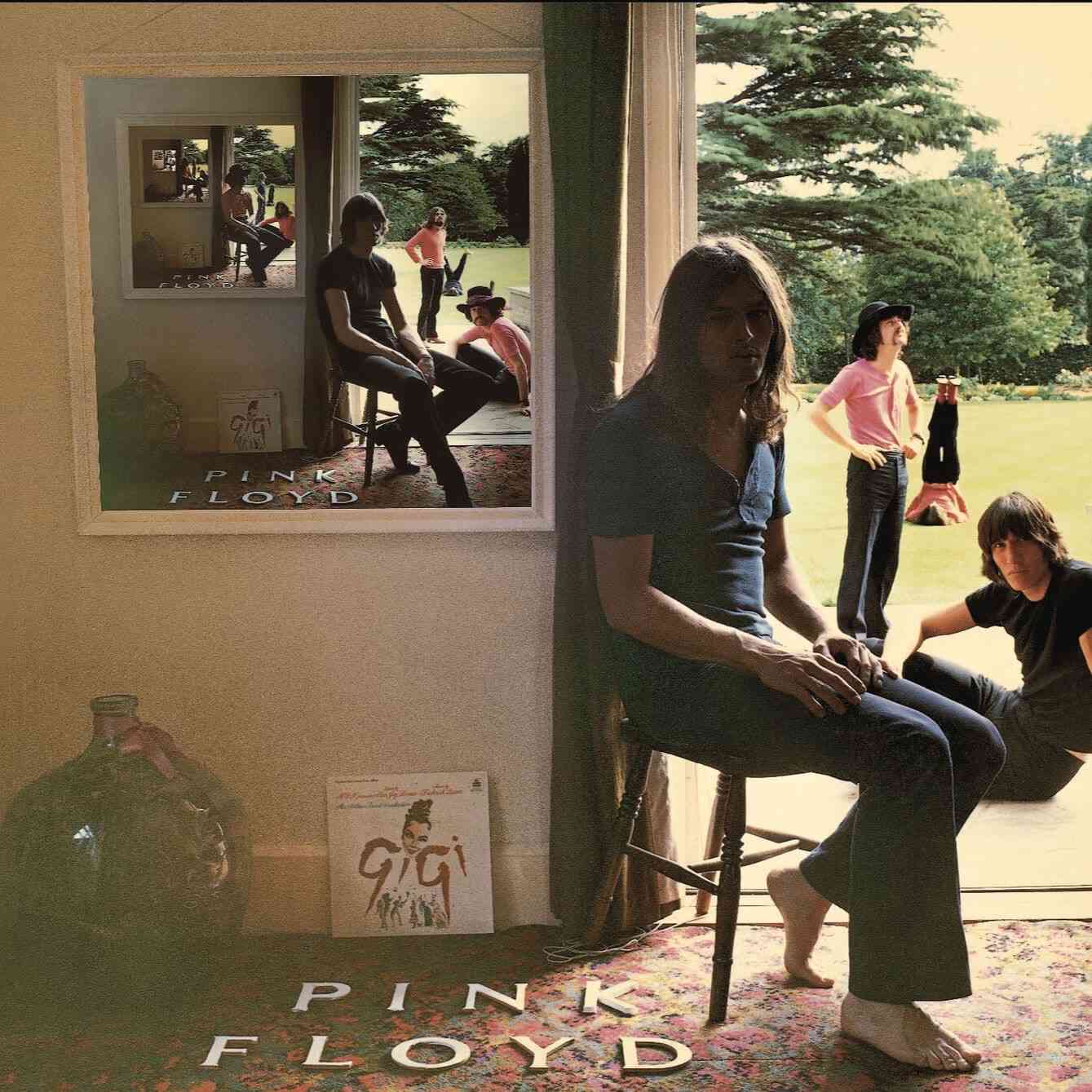
The trick has a name: the Droste effect, borrowed from a Dutch cocoa tin whose label showed a nurse holding a tray bearing the same tin. On the Ummagumma album cover, a framed picture on the wall shows the identical scene, except the band members have swapped places. Inside that picture hangs another picture, and inside that another, receding until the image dissolves into grain.
It’s a beautifully cheap effect and a deeply unsettling one. There’s no digital manipulation here, no compositing software. Hipgnosis built the recursion by rephotographing prints in situ, which is why the light in the deepest frames goes soft and strange.
The Gigi Sleeve and the Airbrush Mystery
Look at the bottom of the UK sleeve, just above the “PINK FLOYD” lettering, and you’ll spot a copy of the Gigi soundtrack propped against the wall. Fans have spent five decades decoding it. Thorgerson eventually admitted the truth at a 2008 talk in Cambridge: it was a red herring, dropped in purely to start arguments. It means nothing.
Record labels were less relaxed. On most American and Canadian pressings, the Gigi sleeve was airbrushed to a blank white rectangle over copyright concerns, though the earliest US copies escaped, and the artwork was restored for the US remastered CD. Australian pressings went furthest and erased it completely, leaving bare floor. If you own an original UK Harvest pressing, you own the cover as it was meant to be seen.
Where the Ummagumma Album Cover Was Shot
The location is not London, not a studio, and not a set. It’s a private home in Cambridgeshire.
Trinity House, Great Shelford
The Ummagumma album cover was photographed at Trinity House, 11 Cambridge Road, Great Shelford, a village roughly four miles south of Cambridge. The shoot used the rear of the property, with those French windows opening onto a manicured lawn and the cedar throwing shade across the garden.
Trinity House is a substantial Edwardian mansion sitting on nearly four acres. When it came onto the market in 2017 through Savills, the asking price was £3.25 million; the listing said nothing at all about Pink Floyd, though local press was quick to fill in the gap.
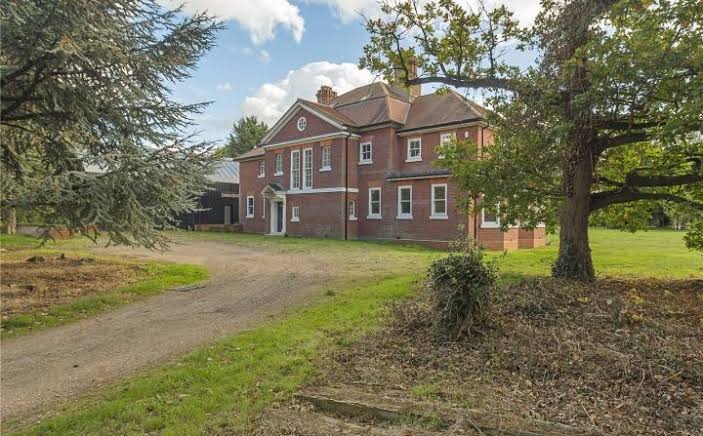
One important note for pilgrims: Trinity House is a private residence and always has been. There’s no plaque, no tour, no gate to lean over. Admire it from the internet.
Storm Thorgerson’s Personal Connection to the House
Thorgerson didn’t find this house through a location scout. He knew it. His girlfriend at the time, Libby January, whom he later married, grew up there, the daughter of a local estate agent. When Hipgnosis needed a room with depth, light and a long view onto a lawn, Storm already had the perfect one in mind, and he knew exactly who to ask.
That personal thread is what turns the Ummagumma album cover from a clever optical trick into something closer to a memory.
The 1965 Party: Where Gilmour and Barrett First Shared a Stage
Here’s the part that makes the location genuinely significant rather than merely convenient.
On 1 October 1965, Trinity House hosted a 21st birthday party for twins Rosemary and Libby January. A marquee went up in the garden. Two local bands were booked. Neither of them was famous, and one of them didn’t even have a settled name yet.
The Tea Set Meets Jokers Wild
The first band was The Tea Set: Syd Barrett, Roger Waters, Richard Wright and Nick Mason. They’d been drifting between that name and “Pink Floyd” throughout 1965 and wouldn’t fully commit to the latter until the following year.
The second was Jokers Wild, a well-drilled Cambridge harmony group whose guitarist was a young David Gilmour.
Pink Floyd historians treat that evening as a landmark: it was the first time present and future members of the band played on the same bill. Gilmour was, in the words of one local Floyd researcher, now “in the know”, a connection that mattered enormously when Barrett’s condition made a replacement necessary in early 1968.
You Might Also Like









Four years and one lineup change later, Thorgerson brought the band back to that garden with a camera.
The Unknown Paul Simon Who Played That Night
There’s a footnote to the party that sounds invented but isn’t. Paul Simon, then an unknown American folk singer working the UK circuit, got up and performed too; his set reportedly included “Where Have All the Flowers Gone.” Guests remember him scrambling onto the stage and toppling off it, and a group of gatecrashers turning up partway through.
Three months later, in January 1966, “The Sound of Silence” hit number one in the United States.
A birthday party in a Cambridgeshire village, October 1965: the future of Pink Floyd in one marquee, and Paul Simon falling off the stage.

The Back Cover: Biggin Hill and the Roadies
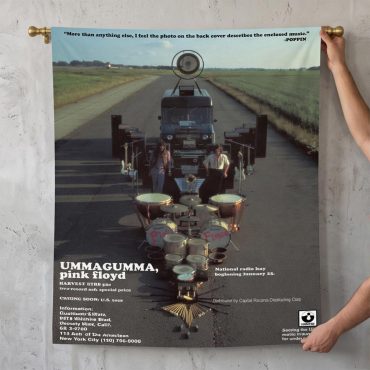
Flip the sleeve and the mood snaps from dreamlike to forensic. The band’s entire touring rig- amps, drums, guitars, cymbals, cables- is laid out across a taxiway at Biggin Hill Airport in London, arranged with the cold precision of an aircraft parts diagram.
Standing with it are roadies Alan Styles and Peter Watts. Styles would get his own immortality a year later as the voice of “Alan’s Psychedelic Breakfast” on Atom Heart Mother. It’s a quietly generous gesture: the front cover belongs to the band, the back belongs to the crew who hauled the gear.
Why the Ummagumma Album Cover Still Fascinates Fans
Most great sleeves work because of one strong idea. This one works because of three, stacked: an optical illusion you can’t quite resolve, a hidden joke nobody was meant to solve, and a real place carrying real history that the image never mentions.
That layering is exactly why it hangs so well on a wall. The recursion rewards a long look, which is more than most album art can claim, and it’s why the design translates so naturally onto a Pink Floyd poster or a canvas print rather than staying trapped at 12 inches square.
It’s also the deep-cut credential. Anyone can recognise the prism. Recognising a Great Shelford garden is a different level of fandom entirely, the kind that starts conversations at gigs, which is half the appeal of a well-chosen Pink Floyd t-shirt.
Frequently Asked Questions
Where was the Ummagumma album cover photographed?
At Trinity House, 11 Cambridge Road, Great Shelford, Cambridgeshire, about four miles south of Cambridge. The shoot used the rear of the property, looking out over the garden.
Who designed the Ummagumma album cover?
Hipgnosis, the design partnership of Storm Thorgerson and Aubrey Powell, who went on to create the sleeves for Atom Heart Mother, The Dark Side of the Moon, Wish You Were Here and Animals.
Why was the Gigi album removed from some pressings?
Copyright caution. Most US and Canadian editions airbrushed the Gigi soundtrack sleeve to plain white; Australian pressings removed it entirely. Thorgerson later confirmed it had no meaning and was included purely to provoke debate.
Can you visit the Ummagumma house?
No. Trinity House is a private residence with no public access. Great Shelford itself is a pleasant village to walk through, but the house should be left in peace.
Conclusion
A recursive room, a red-herring record sleeve, and a garden where two Cambridge bands once played a birthday party, the Ummagumma album cover is the most quietly personal image Pink Floyd ever released, and forty-plus years of fans have only half decoded it.
If that story is the kind of detail you collect, wear it and hang it. Browse the full range of Pink Floyd prints, apparel and wall art at OtherBrick and give the Ummagumma album cover the wall space it has always deserved.



