
News
Dark Side of the Moon Eclipse: What Happens August 12
On August 12, 2026, the Moon will slide in front of the Sun, six planets will line up before dawn, and the Perseids will streak across a moonless sky, all in a single day. For anyone who has ever put on The Dark Side of the Moon and stared at the ceiling, this is the real Dark Side of the Moon eclipse. Here is exactly what happens, where to see it, and why Pink Floyd has more claim to a day like this than any other band alive.
Table of Contents
Three sky events, one day: what is actually confirmed
Plenty of websites are calling August 12 a “celestial trifecta,” and for once the hype has real numbers behind it. But the three events are not equal, and they are not all visible from the same place. Here is the honest breakdown.
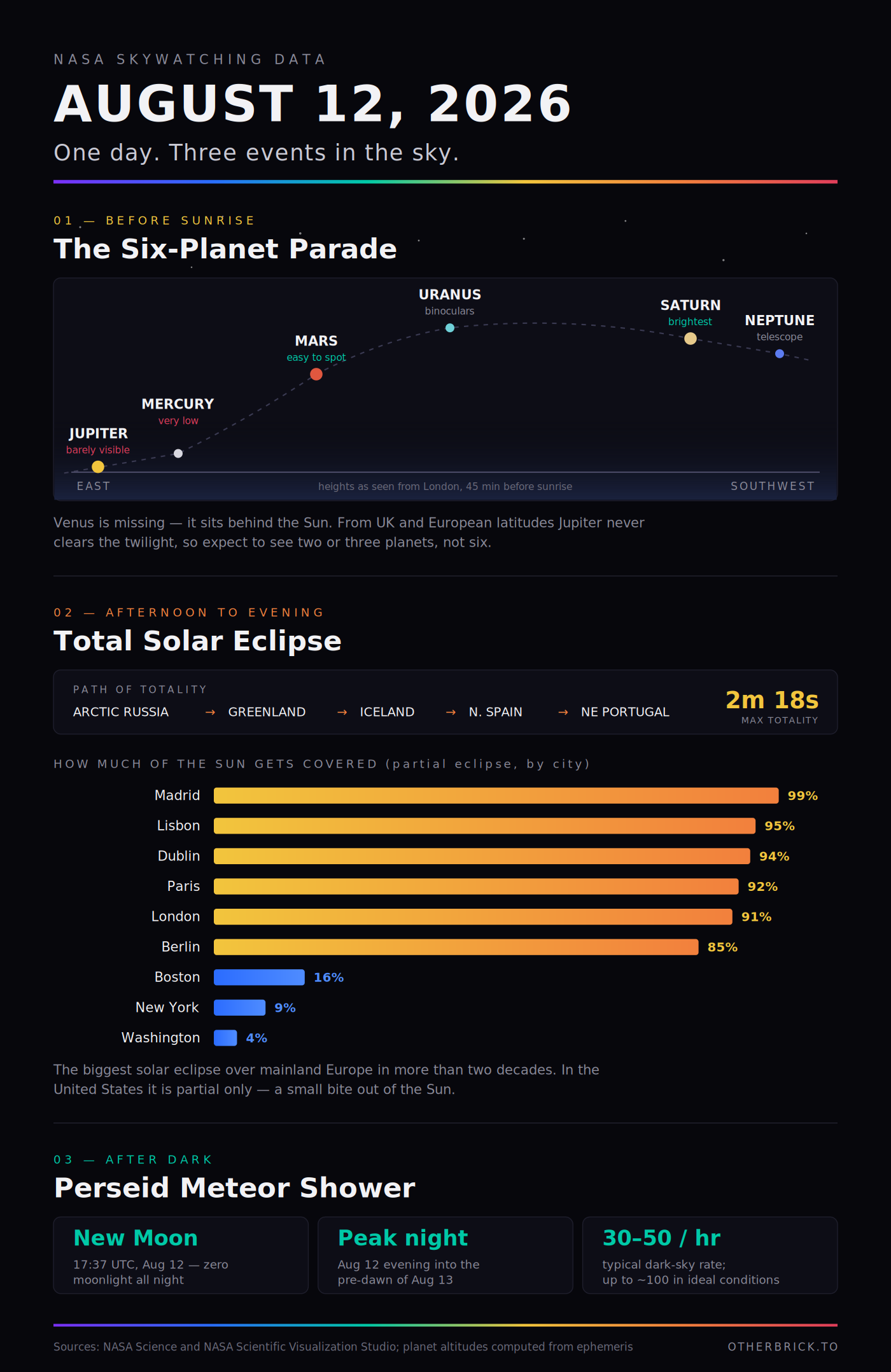
- Before sunrise: six planets spread along the eastern-to-southwestern sky.
- Afternoon into evening: a total solar eclipse across a narrow northern path, partial almost everywhere else in the Northern Hemisphere.
- After dark: the Perseid meteor shower peaks under a brand-new Moon.
The reason all three collide is not coincidence, and it is not mystical. A solar eclipse can only happen at new Moon, and a new Moon is exactly what makes a meteor shower spectacular. The same lunar geometry that blocks the Sun by day leaves the sky pitch black by night.
Why this eclipse matters far more in Europe than in America
This is where most coverage gets sloppy. According to NASA, the path of totality runs across northern Russia, Greenland, Iceland, the North Atlantic, northern Spain, and a small corner of Portugal. Everywhere else in the Northern Hemisphere gets a partial eclipse, and “partial” covers a huge range.
| City | Maximum (local time) | Sun covered |
|---|---|---|
| Madrid, Spain | 8:32 p.m. | 99% |
| Barcelona, Spain | 8:29 p.m. | 99% |
| Lisbon, Portugal | 7:36 p.m. | 95% |
| Dublin, Ireland | 7:10 p.m. | 94% |
| Paris, France | 8:17 p.m. | 92% |
| London, UK | 7:13 p.m. | 91% |
| Berlin, Germany | 8:08 p.m. | 85% |
| Boston, USA | 1:55 p.m. | 16% |
| New York, USA | 1:54 p.m. | 9% |
| Washington, D.C., USA | 1:53 p.m. | 4% |
Read that table again. London at 91% and Washington at 4% are not the same event. If you are in the UK or mainland Europe, this is the biggest solar eclipse you will see in decades, the biggest solar eclipse over mainland Europe in more than two decades. If you are in the United States, from Alaska down to North Carolina, NASA’s own description is a small bite taken out of the Sun.
Totality itself is short. At its longest, near the centerline over the North Atlantic between Greenland and Iceland, the Sun stays fully covered for 2 minutes and 18 seconds. Compare that to the 4 minutes and 28 seconds of the April 2024 North American eclipse, and you understand why eclipse chasers are booking flights to Reykjavík rather than waiting at home.
Not in the path? NASA will stream the whole thing live from 1:15 p.m. EDT on August 12.
The six-planet parade, and what you will realistically see
Before the Sun comes up on August 12, six planets will be spread along the ecliptic: Jupiter, Mercury, Mars, Uranus, Saturn and Neptune. Venus is the one missing, because it sits behind the Sun from our point of view and is completely lost in the glare.
Now the part the clickbait leaves out. Saturn is the star of this line-up, bright and sitting comfortably high in the south. Mars is the next easiest, well up in the east but noticeably fainter than most people expect. After that it falls apart quickly. Uranus needs binoculars, and Neptune needs a telescope. Mercury hangs only a few degrees above the horizon in a sky that is already brightening.
And Jupiter, despite being the brightest object in the entire group, is the one you almost certainly will not see. From London, Dublin, Paris or Berlin it is still scraping the horizon as twilight takes over, under two degrees up by the time the sky is too bright to bother. Anyone promising you six planets is selling you a picture, not a plan. Two or three is the realistic count, and Saturn plus Mars is a fine morning’s work.
It is also worth saying plainly: the planets do not form a straight line in three-dimensional space. They orbit in roughly the same plane, so from Earth they appear strung along the same arc across the sky. That is all a “planet parade” is. It has no gravitational effect on Earth whatsoever, no earthquakes, no weather, no cosmic significance beyond how good it looks at 5 a.m.
One more honest note: NASA’s own August 2026 skywatching guide does not list the planet parade as a headline event at all. It highlights the eclipse, the Perseids, Venus at greatest elongation, and the partial lunar eclipse on August 27-28. The parade is real, but “parade” is a marketing word, not an astronomical one.
When Pink Floyd soundtracked the Moon: the “Moonhead” story
Here is the part that makes August 12 feel like Floyd’s day rather than just a nice coincidence.
On July 20, 1969, as Apollo 11 descended toward the lunar surface, the BBC ran an overnight broadcast, a one-hour BBC1 Omnibus special with the wonderfully British title So What If It’s Just Green Cheese? Between commentary, Ian McKellen and Judi Dench reading Moon poetry, and a panel of scientists, the producers needed something to fill the air. So they pointed a camera at Pink Floyd and let them play.
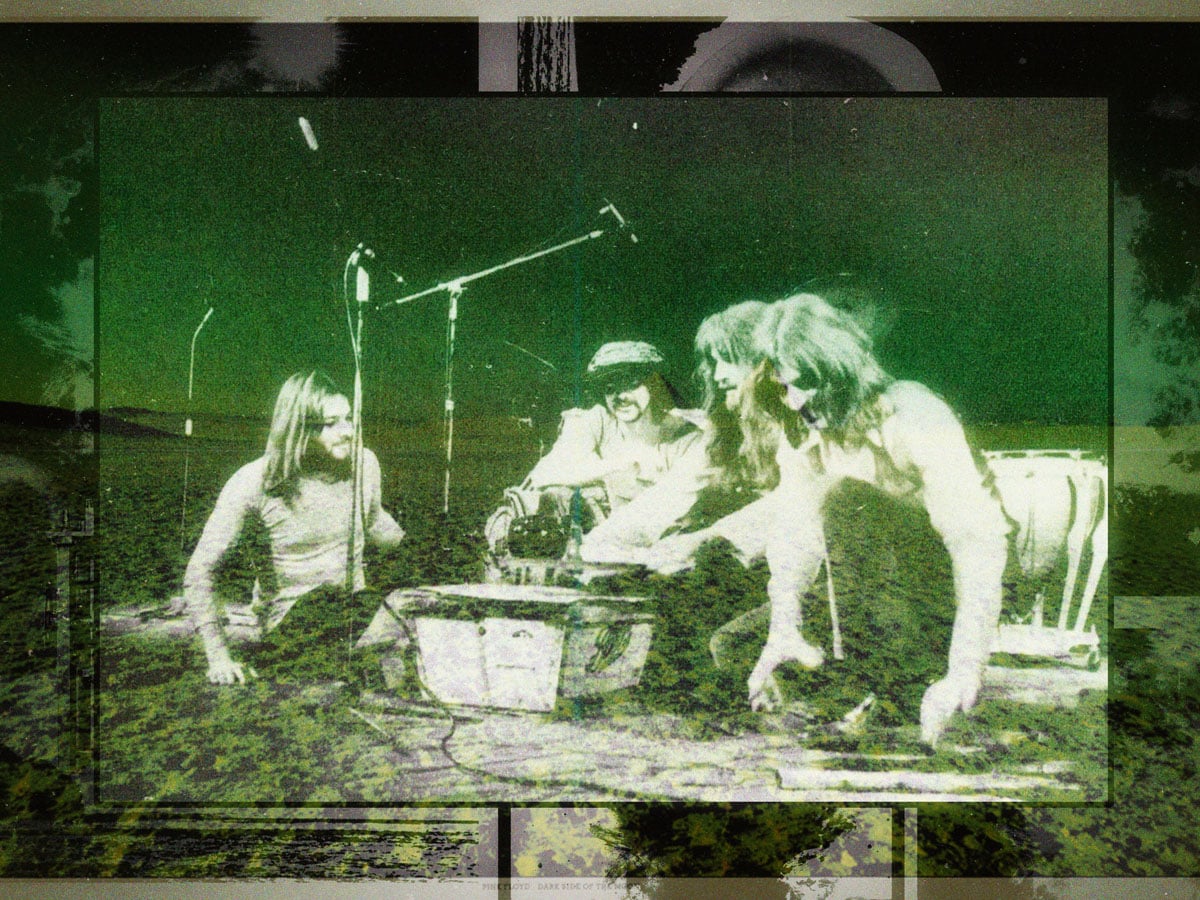
The band improvised for about five minutes. David Gilmour, then 23, told The Guardian in 2009 that they were in a BBC studio jamming to the landing, with the scientists on one side of the room and the band on the other. He described the piece as a nice, atmospheric, spacey, 12-bar blues.
The jam became known as “Moonhead.” It circulated on bootlegs for decades and did not get an official release until 2016, when it appeared in The Early Years 1965-1972 box set.
Think about what that means. The single most-watched moment in the history of human spaceflight had Pink Floyd playing live underneath it. Fifty-seven years later, the sky is doing something extraordinary again, and the band that scored the first one is still the band you reach for.
You Might Also Like






The Pink Floyd songs that belong to August 12
If you are building a playlist for the eclipse, the obvious picks are also the right ones.
“Eclipse”
The closing track of The Dark Side of the Moon (1973), and the song the whole album has been walking toward for forty-two minutes. It resolves everything, then drops into a heartbeat and silence. Cue it up for the moment the Sun goes dark, and you will understand why people cry at eclipses.
“Astronomy Domine”
Syd Barrett’s opener on The Piper at the Gates of Dawn (1967), and the most literally astronomical thing the band ever recorded — a list of planets delivered like a transmission from somewhere much further out.
“Set the Controls for the Heart of the Sun”
From A Saucerful of Secrets (1968). Given that this is a solar eclipse, the title alone earns its place.
A note for the fans who know: The Dark Side of the Moon was never really about astronomy. Roger Waters has said many times that the title refers to lunacy, to the pressures that push people over the edge. The Moon in that album is a metaphor. On August 12, for once, it is also just the Moon.
If you want to mark the day with something you can actually wear, our Dark Side of the Moon collection is the natural place to start, and the Artemis II collection sits at the exact intersection of Floyd and modern spaceflight.
How to watch safely, and not get fooled by the hype
None of this is worth an eye injury, and every year people learn that the hard way.
- Use certified eclipse glasses meeting the ISO 12312-2 standard, or a safe handheld solar viewer, any time any part of the Sun’s disk is visible. Regular sunglasses are never safe, no matter how dark.
- Never look through binoculars, a telescope, or a camera lens while wearing eclipse glasses. The concentrated light burns straight through the filter. Optics need a purpose-built solar filter fitted to the front.
- No glasses? Use a pinhole projector. A hole punched in an index card, with the Sun at your back, projects a safe image onto the ground. Gaps between leaves do the same thing for free.
- Only during totality, and only if you are inside that narrow path, is it safe to look directly at the eclipsed Sun.
- For the Perseids, get away from city lights, look toward the northeast once it is fully dark, and give your eyes a full 30 minutes to adjust. No equipment needed.
Frequently asked questions
Can I see the total solar eclipse from the United States?
No. The path of totality does not touch the United States. Parts of the country from Alaska to North Carolina will see a partial eclipse, with coverage ranging from roughly 37% in Fairbanks down to 3% in Detroit. NASA’s live stream starts at 1:15 p.m. EDT.
What time is the eclipse in London?
The partial eclipse begins at 6:17 p.m., reaches maximum coverage of 91% at 7:13 p.m., and ends at 8:06 p.m. local time. The Sun will be low in the western sky, so you need a clear western horizon.
Is the planet parade dangerous or meaningful?
Neither. It is a line-of-sight effect along the ecliptic, not a physical alignment, and it has no measurable influence on Earth. Enjoy it as a view, not as an omen.
How many meteors will I actually see?
The theoretical maximum for the Perseids is around 100 per hour under perfect conditions, but a realistic rate from a genuinely dark site is closer to 30 to 50 per hour. From a suburban backyard, expect considerably fewer. The moonless sky is the good news.
What is the “Moonhead” recording?
A roughly five-minute improvisation Pink Floyd performed live in a BBC studio during the Apollo 11 landing broadcast on July 20, 1969. It was officially released in 2016 as part of The Early Years 1965–1972.
One day, one sky, one album
August 12, 2026 will not repeat. The next total solar eclipse over mainland Europe, the next Perseid peak on a new Moon, the next morning with six planets strung across the dawn, they will each come around again, but not together, and not for a very long time.
Set an alarm before sunrise. Find a horizon. Charge your phone and check your eclipse glasses now, not on the day. And when the Sun starts to disappear, put on the record the whole thing is named after, because the Dark Side of the Moon eclipse deserves the right soundtrack.
Browse the Dark Side of the Moon collection at OtherBrick and mark the day properly.
Sources: NASA Science — Total Solar Eclipse on August 12, 2026; NASA — What’s Up: August 2026; planet altitudes computed from ephemeris for 51.5°N; David Gilmour interview, The Guardian (2009).



