
News
Pink Floyd 1972 Tour Wichita Before The Dark Side of the Moon
The Pink Floyd 1972 tour brought an evolving version of The Dark Side of the Moon to audiences months before its release. A September 13 concert poster from Wichita, Kansas, opens a window onto that remarkable period, when familiar songs were still finding their final shape.
Today, it is difficult to separate the album from its finished sound. We expect the electronic rush of “On the Run” and the soaring, wordless vocals of “The Great Gig in the Sky.” But those elements were not always there. Looking back at 1972 means encountering a work whose identity was already emerging, while some of its most memorable moments remained ahead.
Table of Contents
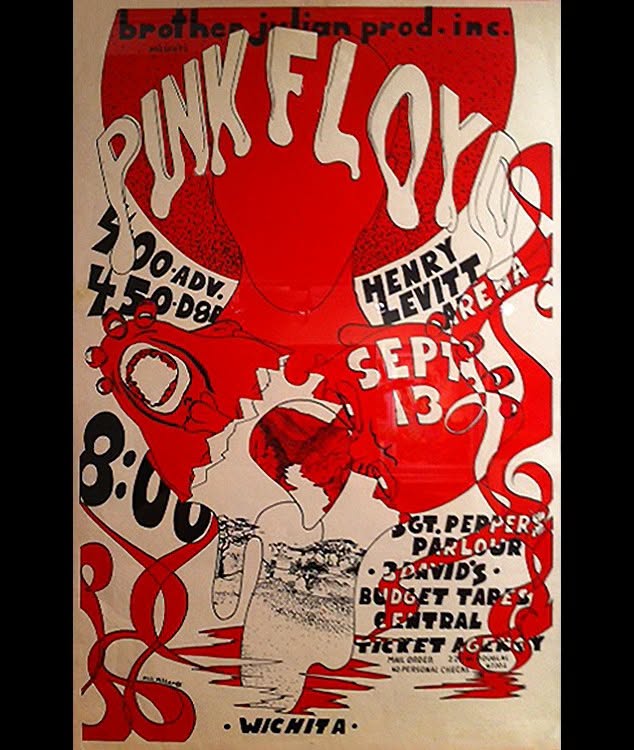
The Wichita Poster: September 13, 1972
The poster advertises Pink Floyd at Henry Levitt Arena in Wichita on September 13. Its swirling lettering, red-and-cream imagery, and black accents give it a distinctly psychedelic character. Before reading the smaller print, you notice the oversized band name stretching across the design.
Pink Floyd Archives identifies the Wichita poster as the work of Phil Miller and dates the concert to September 13, 1972. The venue and date are also recorded in Neptune Pink Floyd’s concert archive.
What makes this image compelling is its place in the story. The show took place roughly six months before the album’s March 1973 release. This was a concert advertisement from the period when Dark Side was becoming the record we know, rather than a retrospective celebration of an established classic.
The Pink Floyd 1972 Tour and an Album Still Taking Shape
According to Pink Floyd’s official 1972 timeline, the band began another American and Canadian tour in Austin on September 8. Wichita followed within that opening week, placing the concert in the autumn chapter of the band’s development of Dark Side.
There is something fascinating about that sequence of events. Audiences were encountering a major new work before they could take home its finished studio recording. For listeners discovering it at a concert, the music had to introduce itself without the familiarity that now accompanies almost every transition.
For fans revisiting this era, that reverses the usual listening experience. Instead of comparing a concert performance with an album already memorized, we can follow the music toward its eventual destination. The arrangements become creative decisions in progress, and the differences become part of the attraction.
How the Early Dark Side of the Moon Differed
“The Travel Sequence” Before “On the Run”
One of the clearest differences concerns the passage following “Breathe.” During 1972, this position was occupied by “The Travel Sequence,” a guitar-and-keyboard instrumental that preceded the electronic “On the Run” heard on the album. The documented history of the tour describes this earlier arrangement continuing through that year’s performances.
The change matters because it alters the character of the journey. A band-driven instrumental and an electronic sequence create different kinds of momentum. For a listener who knows the finished album intimately, this is one of the most revealing places to compare its earlier and later forms.
From “The Mortality Sequence” to “The Great Gig in the Sky”
The development of “The Great Gig in the Sky” was also substantial. Early in 1972, its predecessor, commonly called “The Mortality Sequence,” featured organ and recorded spoken material. By September, the piece had moved toward a piano-led arrangement closer to the eventual album version, still without its famous female vocal. This progression is described in the song’s recording history.
The distinction between early and late 1972 is important: there was no single, unchanging “1972 version.” Even within that year, the music developed.
Clare Torry recorded her contribution at Abbey Road on January 21, 1973, according to Pink Floyd’s official 1973 timeline. Her performance therefore belongs to a later stage than the Wichita concert.
A Developing Suite, Not a Finished Studio Recording
These changes offer a useful way to approach early Dark Side: listen for the possibilities within the music. A section can occupy a familiar place in the running order while producing a very different effect.
You Might Also Like









The comparisons above describe the wider development of the suite. They should not be treated as a reconstruction of every musical detail played in Wichita that night.
From Brighton in January 1972 to the March 1973 Release
The journey began publicly with a setback. On January 20, 1972, technical problems interrupted the planned live debut at Brighton Dome during “Money.” The band’s official timeline confirms that the performance of the new work was abandoned partway through.
- January 20, 1972: The attempted Brighton debut is interrupted by technical problems.
- May 24, 1972: A month-long recording session begins at Abbey Road.
- September 13, 1972: Pink Floyd’s autumn North American itinerary reaches Wichita.
- January 21, 1973: Clare Torry records her vocal for “The Great Gig in the Sky.”
- March 1973: The Dark Side of the Moon is released, as confirmed in the band’s official biography.
That timeline places Wichita within an extended creative process. To explore the studio side further, see OtherBrick’s guide to Pink Floyd documentaries, including the Classic Albums film about the making of The Dark Side of the Moon.
Why This Wichita Concert Poster Still Matters
A concert poster preserves details that an album sleeve cannot: a particular city, a particular venue, and an invitation to attend on one evening. The Wichita design makes the larger history of Dark Side feel local and tangible.
Its appeal also comes from the distance between what we know now and what the advertisement could promise then. Looking at it today, we bring decades of listening with us. The poster itself belongs to the moment before the finished record existed in the public’s hands.
For collectors, that is a powerful reason to revisit tour artwork. It gives the music a setting. For a later chapter in the album’s live history, OtherBrick’s article on Pink Floyd’s PULSE provides a useful companion read.
Frequently Asked Questions
When did Pink Floyd play Wichita in 1972?
Pink Floyd played Henry Levitt Arena in Wichita, Kansas, on September 13, 1972. The date appears in concert archives and on the surviving poster.
Did Pink Floyd perform The Dark Side of the Moon before its release?
Yes. The band presented early versions during 1972, before the studio album appeared in March 1973. The attempted Brighton debut in January was interrupted.
What was different about the 1972 live version?
Key differences included “The Travel Sequence” and the developing predecessor of “The Great Gig in the Sky.” Arrangements also changed during the year.
Is there a known recording of the Wichita concert?
The Concert Database currently lists the show as “No Known Recording.” That limits what can be confidently said about its exact performance and complete setlist.
Remembering Pink Floyd Before Dark Side’s Release
Part of the pleasure of exploring 1972 is hearing history without assuming that its outcome was inevitable. The finished album can feel so carefully assembled that it is easy to forget the alternatives, revisions, and months of work behind it.
The Wichita poster gives that process a date and a place. It invites us to pause at a moment when the music was already reaching audiences but had not yet become the recording that generations would carry with them.
Explore OtherBrick’s North American Tour 1972 shirt and celebrate the creative spirit of the Pink Floyd 1972 tour.



