
News
Roger Waters’ “What God Wants”: The Story Behind the 1992 Single
On 24 August 1992, Roger Waters’ “What God Wants, Part I” arrived as the lead single from Amused to Death, six minutes of televangelist rage, monkeys on TV screens, and one of Jeff Beck’s most vicious recorded solos. Three decades on, the Roger Waters “What God Wants” single still reads less like a period piece and more like a weather report. Here’s the full story behind it.
Table of Contents
August 24, 1992: The Single That Announced Amused to Death
“What God Wants, Part I” landed two weeks ahead of its parent album, which Columbia released on 7 September 1992. The B-side was “What God Wants, Part III”, a deliberate wink, since the song exists in three parts and only the first was ever pushed as a single.
The setup was familiar to anyone who had lived through The Wall. Waters had a form for splitting one idea across numbered movements and letting the pieces argue with each other across a record, and “What God Wants” follows exactly that blueprint. It also arrived after Radio K.A.O.S., an album most fans and critics treat as the low point of his solo run, so the stakes for this single were high.
What the charts actually say
You will see it claimed online that “What God Wants” topped the American charts. It didn’t, and the real numbers are more interesting than the myth, because they show a song that hit hard on rock radio while barely denting the pop mainstream.
| Chart (1992) | Peak |
|---|---|
| US Mainstream Rock Songs (Billboard) | 4 |
| Norway (VG-lista) | 9 |
| New Zealand (Recorded Music NZ) | 26 |
| UK Singles (OCC) | 35 |
| Netherlands (Single Top 100) | 49 |
| Australia (ARIA) | 103 |
A #4 on Mainstream Rock in the year of Nevermind‘s hangover is no small thing. It meant American FM rock stations were playing a six-minute anti-religion, anti-war screed by a 48-year-old ex-Pink Floyd bassist, in heavy rotation, right through the autumn.
What God Wants, Part 1 Meaning: Waters vs. Dogma
Strip away the sound effects and the song is one long enumeration. Waters lists, item by item, everything that gets done in God’s name: profit, war, punishment, obedience, and lets the accumulation do the work. There is no counter-argument offered and none needed; the joke is that every contradictory thing on the list is claimed with equal certainty.
Waters has been blunt about where the anger came from. He described himself as genuinely upset by religious dogma, and pointed specifically to hearing an American president invoke God’s endorsement of the Gulf War. That, for him, was the trigger: the reduction of political language to a claim of divine backing, delivered on television, in 1991, to an audience watching it like sport.
Three parts, one argument
Parts II and III widen the target. Where Part I is about religion, the later movements fold in money and consumption, worship as a habit that outlives the church and simply relocates to the mall and the screen. Taken together with the rest of the album, the point is about conformity itself: people go along with things not because they chose to, but because going along is easier than not.
That is also why the three-part structure matters. Like the three “Another Brick in the Wall” movements before it, the split lets one motif return in different clothes, so the listener recognises the pattern before Waters names it. Fans who love that architecture usually love The Wall for the same reason.
Jeff Beck’s Guitar: The Voice That Replaced Gilmour
Every great Waters record has needed a guitarist to argue back at him, and on Amused to Death that guitarist was Jeff Beck. Beck played on eight of the album’s songs, and his presence is the single biggest reason the record sounds like a proper band album rather than a solo lecture.
Beck’s playing on “What God Wants” is all bent notes, harmonics, and whammy-bar vocal phrasing, closer to a human voice sneering than to a conventional rock solo. Waters has said openly that he still can’t work out how Beck does it, singling out his pitch and the way he plays melodies on the whammy bar. Coming from the man who spent a decade next to David Gilmour, that’s not a small compliment.
The rest of the cast was equally serious: Patrick Leonard co-producing and playing keyboards, Andy Fairweather Low on guitar, Graham Broad on drums, Luis Conte on percussion, and Michael Kamen, Waters’ orchestral collaborator from The Wall and The Final Cut, conducting the National Philharmonic Orchestra on “Too Much Rope” and “What God Wants, Part III.” Don Henley, Rita Coolidge and P.P. Arnold turn up as guest vocalists elsewhere on the record.
You Might Also Like







The Video: Tony Kaye, Gorillas, and a Frog Skeleton
The promo clip was directed by Tony Kaye, years before American History X, and produced by Sarah Whistler. It is one of the strangest major-label videos of the decade.
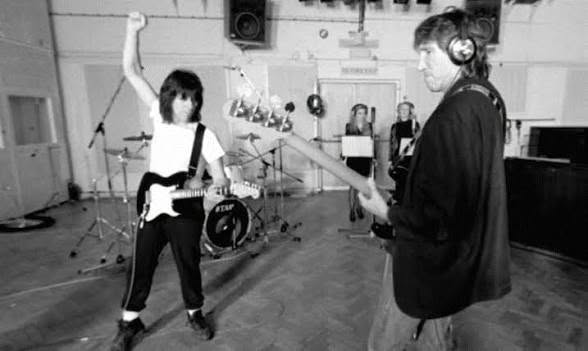
Gorillas sit watching television. A stop-motion frog skeleton picks at a lump of cheese on a mousetrap, gets caught in the wiring, and is fused with the cheese into a small TV set. Animation duties were farmed out to multiple studios, including Pacific Data Images for the CG and Will Vinton Studios for the stop-motion. Cut against black-and-white footage of Waters and the band in the studio, it delivers the album’s thesis without a single line of explanation: the screen consumes whatever it touches, and we watch.
The monkey-on-a-TV sleeve
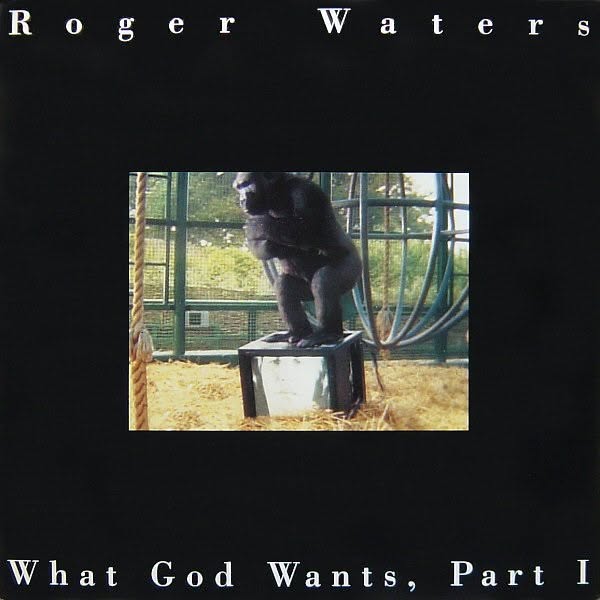
The single’s cover carries the same idea in one frame, an ape standing on top of a television, master of a machine it cannot possibly understand. It’s a blunt image, and blunt is the point. When the album was reissued in 2015 with a James Guthrie 5.1 remix, the artwork was redrawn by Sean Evans, creative director of Waters’ The Wall Live tour, and the video was reissued in a cleaned-up widescreen version.
Why Amused to Death Sounds Even Truer in 2026
The album takes its name from Neil Postman’s 1985 book Amusing Ourselves to Death, which argued that television had turned public discourse, news, politics, religion, education- into entertainment, and that a population entertained into passivity needs no censor. Waters took that thesis, set it to music, and mixed the whole thing in QSound, so the sounds circle the listener’s head like a room they can’t leave.
In 1992 that was a warning about TV. Read it now, with a phone in your hand and an algorithm deciding what you’re angry about today, and the record has quietly become documentary. Waters himself said as much around the 2015 reissue: most of what he had to say back then still applied, and had arguably got worse. That is the strange afterlife of this album, it keeps getting more accurate, which is not a compliment anyone wanted.
Wear the Message: Pink Floyd & Roger Waters Merch at OtherBrick
If this song is in your bloodstream, you already know the appeal of wearing the artwork rather than just streaming the record. At OtherBrick, we build print-on-demand Pink Floyd pieces for fans who actually know the catalogue — not generic band merch with a prism slapped on it.
- Pink Floyd T-shirts: the everyday pick, printed for fans who get the reference without needing it explained.
- Pink Floyd posters and canvas prints: for the wall above the turntable, where they belong.
- The Wall collection: the obvious companion piece if the three-part structure of “What God Wants” is what pulls you in.
Everything ships to the US, UK, and across Europe.
FAQ
Did “What God Wants” chart in the US?
Yes. “What God Wants, Part I” reached #4 on Billboard’s Mainstream Rock Songs chart in 1992. It did not top the Billboard Hot 100 — the claim that it was an American number one is a persistent piece of internet misinformation.
Who plays guitar on “What God Wants, Part I”?
Jeff Beck. He appears on eight tracks across Amused to Death, with Andy Fairweather Low also contributing guitar to the album.
Why is the song split into three parts?
Waters used the same device he’d used on “Another Brick in the Wall”, one recurring theme across three movements, each shifting the target. Part I takes on religious dogma; the later parts extend the argument to materialism and mass consumption. Only Part I was released as a single, with Part III as its B-side.
Is Amused to Death a Pink Floyd album?
No. It’s Roger Waters’ third solo studio album, released in September 1992, five years after he left the band. Pink Floyd’s own release of that era was The Division Bell in 1994.
Conclusion
“What God Wants, Part I” was never a chart-topper, and it was never trying to be. It was a six-minute provocation with a legendary guitarist attached, aimed at a country watching a war on television, and it found its audience on rock radio anyway. Thirty-four years later, Roger Waters’ “What God Wants” still lands, which says more about us than about the song.



