
News
700 Beds, 2 Attempts: A Momentary Lapse of Reason Cover
Here’s a fact that still blows minds almost four decades later: every single bed on the A Momentary Lapse of Reason album cover is real. No photo montage, no CGI, just 700 wrought-iron hospital beds hauled onto an English beach and arranged by hand. This is the full story of how Pink Floyd and Storm Thorgerson pulled off one of the most audacious album covers in rock history.
Table of Contents
A New Era Needed a New Image (1987)
By 1987, Pink Floyd was a band reborn and under pressure. Roger Waters had walked away two years earlier, and David Gilmour was steering the ship for the first time, with Nick Mason at his side and Richard Wright returning to the fold. The album that would announce this new chapter, released on September 7, 1987, needed a visual statement powerful enough to say: Pink Floyd is still Pink Floyd.
So the band turned to the man who had defined their visual identity for over a decade. Storm Thorgerson, the design genius behind the prism of Dark Side of the Moon and the burning handshake of Wish You Were Here, was working on a Pink Floyd studio album for the first time since 1977’s Animals. His inspiration came from a single line in the song “Yet Another Movie”, “a vision of an empty bed”. In Thorgerson’s imagination, that one empty bed multiplied into a surreal river of beds flowing toward the sea.
Why Saunton Sands? The Beach from The Wall
To bring the vision to life, Thorgerson chose Saunton Sands in North Devon, England, a vast, flat stretch of golden sand that seems to run forever at low tide. If that beach looks familiar to die-hard fans, it should: several unforgettable scenes from the 1982 film Pink Floyd, The Wall, were shot on the very same sands. There’s something poetic about the band returning to that location for the cover that would open its post-Waters era.
The beach’s enormous scale was exactly what the concept demanded. Thorgerson didn’t want a clever studio composite; he wanted the camera to capture hundreds of beds genuinely receding toward the horizon, with real light, real tide lines, and real sky. (Fans of The Wall can browse our Pink Floyd The Wall collection for designs inspired by that era.)
700 Hospital Beds and Zero Photo Tricks
Hauling Iron Beds onto the Sand
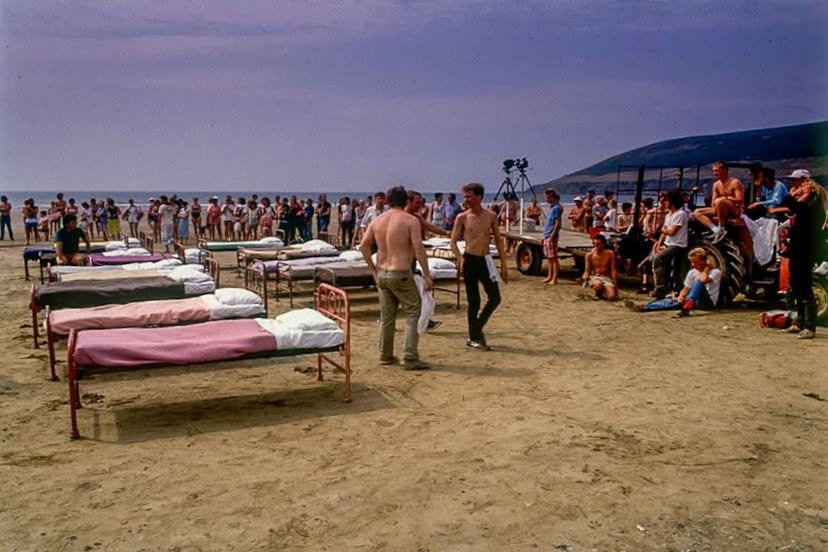
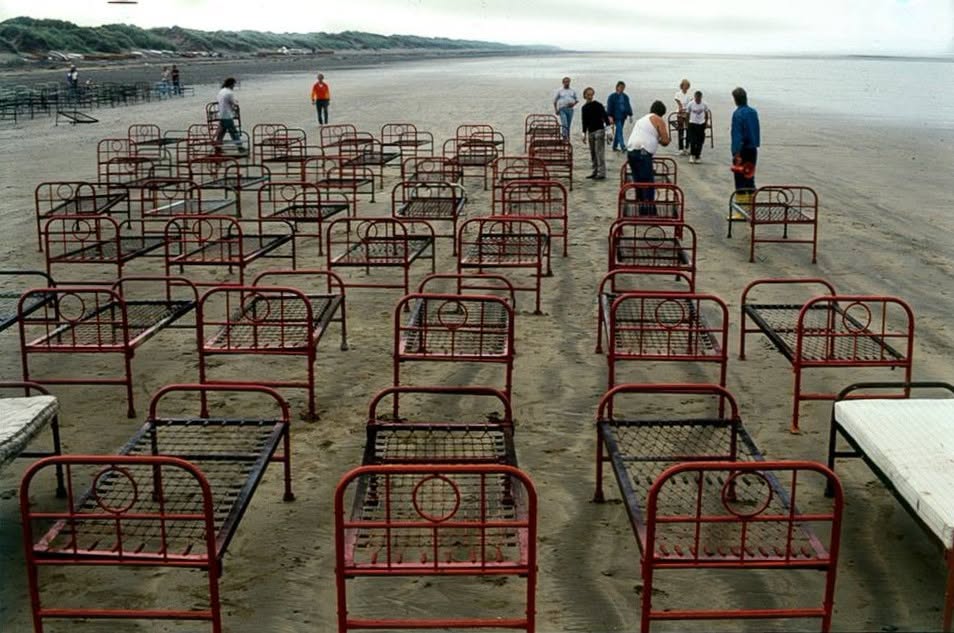
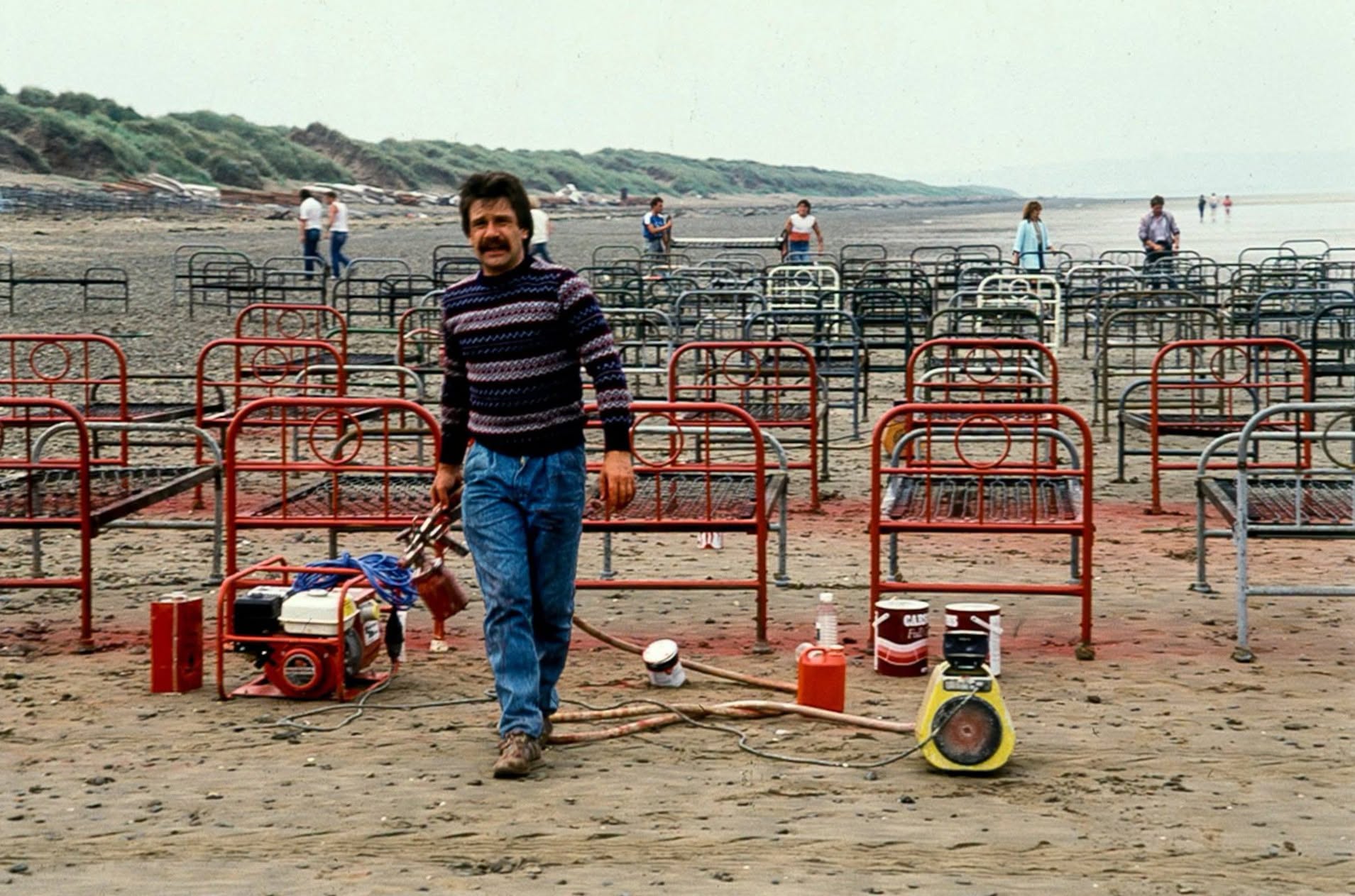
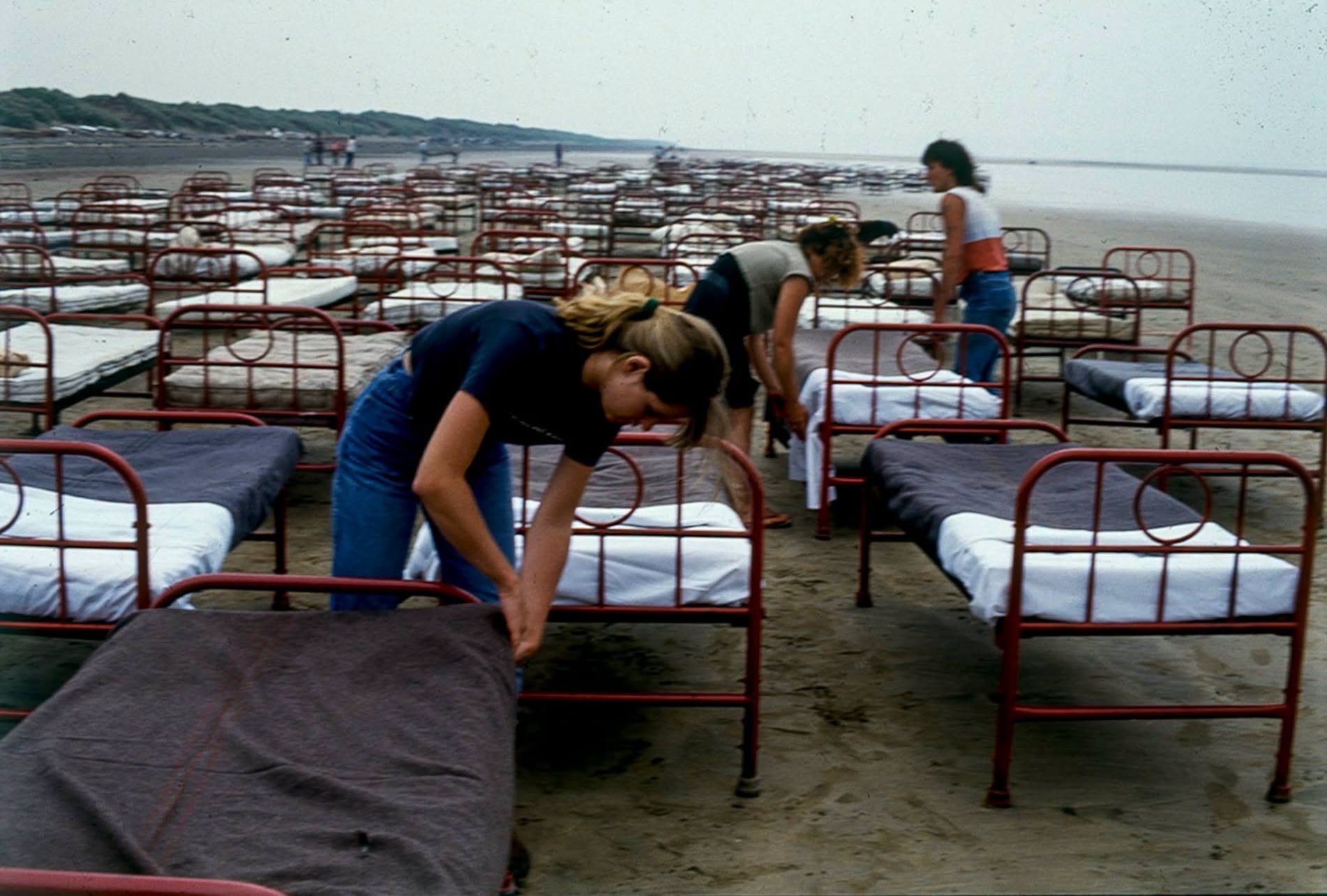
In July 1987, the production team transported roughly 700 wrought-iron hospital beds, each one separately made up with sheets and pillows, from London down to Devon, then positioned them one by one on the beach. Some books cite 700 beds, but Thorgerson himself always insisted on 700, and he was the one counting. Arranged by Thorgerson’s colleague Colin Elgie, the beds formed a winding river of white linen stretching toward the Atlantic. Look closely at the sky, and you’ll spot a tiny aircraft, a playful nod to the album’s hit single “Learning to Fly.”
You Might Also Like








When the Rain Ruined Everything
Then the English weather did what English weather does. Midway through the first attempt, a grey drizzle rolled in so thick that the distant half of the beds vanished into the murk. The shot was unusable. The crew had no choice but to clear every single bed off the beach, and then set them all up again for a second attempt. Madness? Absolutely. Thorgerson admitted as much himself. But that stubborn refusal to fake it is exactly what makes this cover legendary.
Robert Dowling’s Iconic Shot
When the skies finally cooperated, photographer Robert Dowling captured the definitive image: an endless procession of beds dissolving into sea and sky. The entire production took about two weeks from start to finish. The effort paid off spectacularly – Dowling won a gold award at the Association of Photographers Awards for the photograph, cementing it as one of the great visual masterpieces in Pink Floyd’s history. Some pressings even feature alternate versions, including one with a nurse making up one of the beds.
What Does the A Momentary Lapse of Reason Cover Mean?
Like all great Thorgerson work, the image invites interpretation rather than dictating it. The empty beds evoke absence – Gilmour spoke of “vestiges of relationships that have evaporated, leaving only echoes,” and it’s hard not to read the departed Waters into that. Others see dreams, hospitals, mortality, or the strange logic of the subconscious: a momentary lapse of reason rendered in iron and linen. The beauty is that the photograph is undeniably real, yet feels like something from a dream – the perfect visual metaphor for Pink Floyd itself.
Bring A Momentary Lapse of Reason Home
If this story deepened your love for the artwork, you can make it part of your everyday life. At OtherBrick, we’ve built a dedicated A Momentary Lapse of Reason collection featuring the iconic beds-on-the-beach imagery and 1987-era designs. Hang the surreal seascape on your wall with our Pink Floyd posters and canvas prints, or wear the era proudly with a Pink Floyd t-shirt. Every piece is printed on demand with care, because fans deserve merch made by fans.
FAQ
Was the A Momentary Lapse of Reason cover real or photoshopped?
Completely real. Around 700 actual wrought-iron hospital beds were transported to the beach and arranged by hand. No photo montage or digital manipulation was used, which is part of why the image remains so celebrated.
Where was the album cover shot?
On Saunton Sands in North Devon, England, the same beach where scenes from the film Pink Floyd – The Wall were filmed a few years earlier.
How many beds were used on the cover?
Storm Thorgerson, who organized the shoot, said 700 beds. A few books mention 800, but 700 is the figure from the man himself, and the crew had to set them up twice after rain ruined the first attempt.
Conclusion
The A Momentary Lapse of Reason album cover is proof that the boldest ideas are worth doing for real: 700 beds, two attempts, one unforgettable photograph. Ready to bring a piece of that madness into your world? Explore the full A Momentary Lapse of Reason collection at OtherBrick and carry the legend with you.



