
News
Pink Floyd’s Inflatable Pyramid: The 1975 Tour Story
✓ The answer is B.
On June 18, 1975, in Pittsburgh, the pyramid went completely out of control, and flew right out of the stadium. Three attempts, zero successful deployments.
Keep reading for the full story.
Few bands have attempted stage production as ambitious, or as gloriously doomed, as Pink Floyd’s inflatable pyramid in 1975. Built for their open-air stadium run, it became one of rock’s great backstage disasters. Here’s the full story.
Table of Contents
Pink Floyd in 1975: The “Wish You Were Here” Era
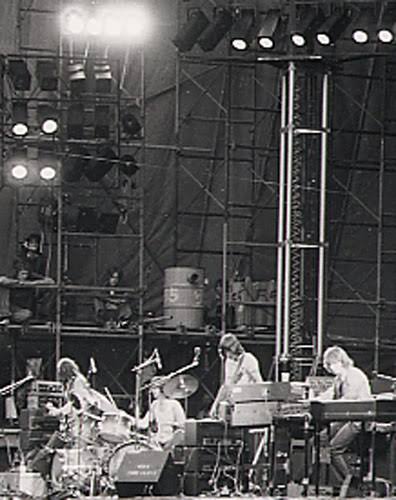
By the summer of 1975, Pink Floyd were no longer just a band. They were an event. The Dark Side of the Moon had spent an almost incomprehensible stretch on the Billboard charts, well over two years by this point, and the band was preparing to release Wish You Were Here, their haunting tribute to Syd Barrett. The music was cerebral, melancholic, and ambitious. And naturally, the live show had to match.
Pink Floyd’s approach to touring had always been ahead of its time. As early as 1972, they were using quadraphonic surround sound systems that left audiences bewildered in the best possible way. Roger Waters, David Gilmour, Nick Mason, and Richard Wright weren’t content to stand on a stage and play; they wanted to build a world around the listener.
Why an Inflatable Pyramid?
For the June 1975 outdoor stadium dates, the band commissioned a giant inflatable pyramid as the centrepiece of the show. The visual logic was obvious: The Dark Side of the Moon prism was the most recognisable image in rock. A towering inflatable pyramid looming over an open-air stadium crowd would have been extraordinary, a physical manifestation of the album artwork brought to life. In theory, it was a stroke of genius. In practice, it was a different story entirely.
Three Attempts, Three Failures: The Full Timeline
The inflatable pyramid made three appearances on the 1975 outdoor run. It did not go well for any of them.
Attempt 1. Opening Night: It Simply Didn’t Deploy
The first attempt to raise the pyramid came on the opening night of the outdoor run. The crew worked to inflate and deploy it before or during the show, and it failed to launch properly. No dramatic incident, no rogue balloon sailing into the crowd. Just an expensive piece of inflatable architecture refusing to cooperate. For a band whose entire live philosophy was built on seamless, cinematic spectacle, it was a deeply unglamorous beginning.
Attempt 2. Jersey City, June 14: High Winds Killed It
The second outdoor date brought the band to Jersey City, New Jersey, on June 14, 1975. The pyramid was ready. The crew was ready. The crowd was ready. The wind was not interested. High winds at the venue made it impossible to safely deploy the structure. Anyone who has ever tried to put up a large tent in a gale will understand the physics; a giant inflatable pyramid in an open stadium with no windbreaks is essentially a sail. The attempt was abandoned. Two shows in, the pyramid had still never properly done its job.
Attempt 3. Pittsburgh, June 18: It Flew Out of the Stadium
The third and final attempt came in Pittsburgh on June 18, 1975. This time, the pyramid did go up. It also went out, straight out of the stadium and into the Pittsburgh sky. What was meant to be a controlled, dramatic centrepiece to the show became, essentially, a giant runaway balloon. The pyramid broke free, caught the wind, and sailed clean over the stadium walls. Whether the crowd watching it disappear into the evening sky found it funnier or more impressive than the intended effect is a matter of debate. Either way, it remains one of the most perfectly absurd moments in live rock history.
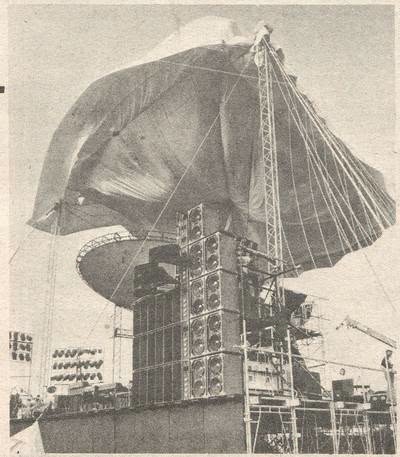
Three outdoor shows. Three failures. The inflatable pyramid’s career in Pink Floyd’s stage production was over.
What This Says About Pink Floyd’s Live Show Philosophy
The pyramid story is funny. It’s also, in a strange way, deeply characteristic of Pink Floyd. This is a band that didn’t fail because they aimed too low. The entire arc of their live production, from the early quadraphonic experiments, through the Animals tour’s giant inflatable pig (which famously also broke free and disappeared into the sky above Battersea Power Station), to the monumental The Wall shows of 1980-81, tells the story of a band perpetually reaching beyond what was technically feasible at the time.
Here are some more photos of the Pyramid
You Might Also Like
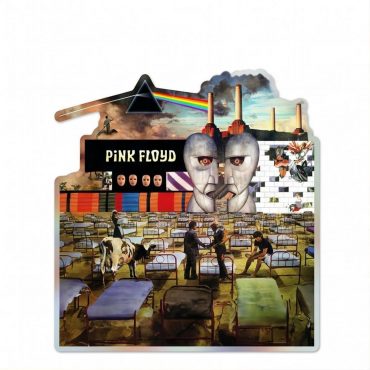











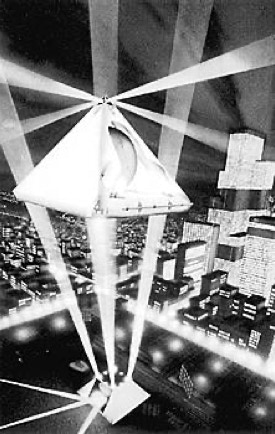
This is what it should have looked like
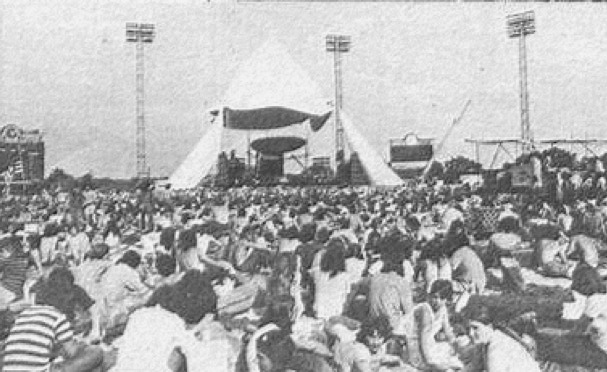
Here is the reality
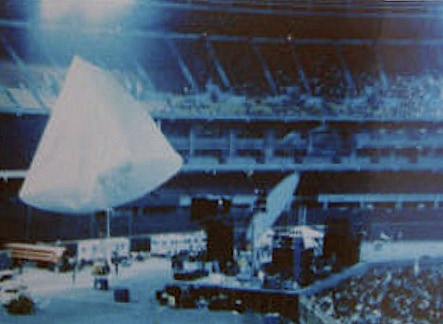
The Animals’ pig incident in 1977 is perhaps more famous, but the 1975 pyramid came first. It established a pattern: Pink Floyd would build something extraordinary, something with genuine visual and conceptual power, and occasionally the weather or physics or plain bad luck would remind them that nature had not read the production schedule.
The failures never stopped them. If anything, the ambition escalated. By the time The Wall tour arrived, they were literally constructing a full wall across the stage during the first half of the show. The inflatable pyramid was, in retrospect, a dress rehearsal for a band learning how far they could push live spectacle, and what happened when it pushed back.
Carry the Spirit of the 1975 Tour With You
The June 1975 run sits at a unique crossroads in Pink Floyd’s history; the band was living in the long shadow of Dark Side of the Moon, while Wish You Were Here was weeks away from completion. It’s a moment that defines everything fans love about them: the ambition, the absurdity, the commitment to doing something no one else would even attempt. If that era of Pink Floyd speaks to you, the prism, the pyramid, the sprawling stadium nights, explore the Pink Floyd Dark Side of the Moon collection at OtherBrick. From t-shirts to posters to canvas prints, every piece is designed for fans who know the story behind the artwork, not just the image itself.
The Pyramid May Be Gone, But the Legend Isn’t
The inflatable pyramid of June 1975 lasted three shows and completed zero of them. It sailed out of a Pittsburgh stadium and was never seen in a Pink Floyd production again. And yet it endures as a perfect encapsulation of what makes this band unlike any other. They dreamed bigger than the sky would allow, and they never once considered dreaming smaller. Browse the Pink Floyd collection at OtherBrick and wear the legacy of the most ambitious, most gloriously unreasonable band in rock history.



